Blücher
Movie Detail

Blücher

Mar 06, 2026 Drama / History / War 7.1/10 5 reviews

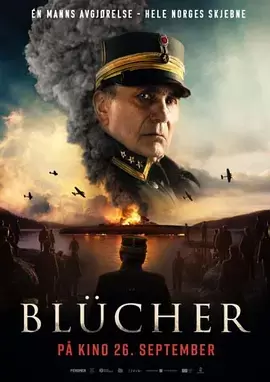
On April 9, 1940, 64-year-old Colonel Birger Eriksen commanded the Oscarsburg Fortress, a crucial checkpoint that all ships bound for Oslo had to pass through.

Writers Melike Leblebicioglu Kaveh
Cast Bjørn Sandqvist / André Bernsen / Elda Ska / Elias Holmen Sørensen / Fridef Soham / More...
Rating Count 1,085

Related Audience Reviews

5 entries
Sort By
{{ review.userInitial }}
{{ review.title }}

{{ review.userName }}

{{ review.ratingLabel }} {{ review.dateLabel }}

{{ paragraph }}

A
Sleep deprivation

Autumn Pants Little Sichuan Pepper

5.0/10 Jan 13, 2026

I love you, China 🇨🇳 Magic is subjecting visually impaired individuals to sleep deprivation torture, a prison-like attack on their physical and mental well-being. This noise-induced sleep deprivation torture was previously used against criminals in India. Does anyone know why magic is doing this?

B
Although the plot is just a small episode in World War II, it's worth watching.

Big Demon King Little Fur Ball

4.0/10 Jan 26, 2026

The title could be changed to "The First Shot Before Norway's Surrender," as it's quite well-made.

The World War II films offer a relatively rare perspective and range of events. Although it's just a small episode in the historical process, it's still worth exploring in depth to see the immense harm an incompetent government can inflict on its people. We here truly understand this all too well.

Although the title refers to a cruiser, this film is not actually a naval battle film, nor is it from the perspective of warships. Instead, it's a World War II film focusing on a naval port fortress. The first half of the film effectively portrays the tense atmosphere and emotions within the fortress, from intelligence gathering to security, and the counterattack in the middle is also well-done. The second half of the film shows the helplessness of the government's incompetence leading to the country's fall, and the officers' subsequent retribution.

J
War Will Come Even Without Preparation: Reflections on Watching "Battleship Blücher" Amidst World Turmoil

Jeff (Moxi)

3.0/10 Jan 31, 2026

1) The shock at the beginning of the film: a peaceful society is pulled back to reality by war.

The strongest feeling at the beginning is that a Nordic country, which has not experienced war for 120 years, is suddenly forced to face reality under the surprise attack of several German warships. The moment the fortress sinks a warship does not bring the "satisfaction of victory," but instead triggers a series of more realistic and poignant psychological reactions:

• From "I can't believe war is so close" to "Is it really happening?"

• Was the order to launch the artillery barrage correct?

• "Has the enemy or friend been hit? Have you confirmed it?"

• They even began to worry: Would this shot undermine neutrality and drag the country into war?

When images of warships being sunk and soldiers fleeing for their lives appear, emotions immediately become complex: even enemy soldiers, life is still life. War is that cruel—it not only kills, but also destroys lives: houses, villages, and warehouses are destroyed, and the destructive power truly impacts the daily lives of ordinary people.

Throughout the entire film, almost no one laughs; the tone is tense and oppressive from beginning to end.

2) The most ironic scene: Only after buying time did they realize the need for a nationwide mobilization.

Even more absurd and ironic: the next morning, the royal family and military withdrew thanks to the time bought by the fortress, and only then did they begin to consider a national mobilization. But the mobilization order had to be sent by mail and would take several days to reach its destination—giving the impression that the country was almost completely unprepared for war.

The core issue then emerges:

Not preparing for war will not prevent war from happening.

The country was unprepared, and war really came, and it came more suddenly and more heavily.

3) The mobilization speech was interrupted by an air raid: the old order shattered instantly in the face of modern warfare.

At dawn, the colonel was just about to deliver a rousing speech to the soldiers—"Fight to the death to defend the fortress!"—and began distributing rifles. That moment was very much like the opening scene of a traditional war narrative where "morale is ignited."

But the next second, German bombers arrived.

Lacking effective command and preparation, the soldiers in a naval fortress were thrown into chaos by the air raid: seeking cover, fleeing for their lives, and squeezing into underground tunnels. The roar of bombs overhead made it clear that this was not a matter of "bravery," but rather that they were simply unprepared to face such a pace of warfare and such overwhelming firepower.

Then, an even more cruel question began to emerge in everyone's mind:

Surrender or fight to the death?

This was no longer a tactical question, but a test of everyone's psychological limits. The colonel was also looking at the soldiers, at his daughter and family—he had to decide whether to exchange "futile sacrifices" for a name that might be written into history.

4) Two choices weigh on one person's shoulders: first, "To shoot or not to shoot," and second, "To throw or not to throw."

One of the most piercing tensions in the film comes from two crucial choices:

• The night before: To fight or not to fight

• The next day: Surrender or not?

Making the "correct choice" the first time (sinking the enemy ship) will not make the second time easier, but rather more difficult: the situation has changed, and the correct choice has also changed; and the second choice (surrender or fight to the death) cannot be verified at the moment, and one can only bear the consequences.

5) Emotional peak: The moment of accepting surrender negotiations

The moment the colonel accepted the surrender negotiations was the most emotionally charged moment in the entire film: his eyes and nose were red, and he was deeply moved. That kind of excitement was not simply fear or anger, but rather like a physiological dam breaking down after a person has been pushed to their limit by responsibility: humiliation, rationality, guilt towards his subordinates, responsibility to the country, and a premonition of the fate of his own reputation all burst forth in the same second.

Surrender is not "giving up," but rather taking on another responsibility—to ensure more people survive, to allow the fortress to fall, and to endure possible humiliation and misunderstanding. Both choices are weighty, just with different costs.

6) Black and White vs. Color: The Trial Structure's Inquiry into "Right and Wrong"

The film employs a trial/investigation-like format throughout, and uses two colors to distinguish the narrative layers:

• Color: Returning to the moment the event occurred, real, vivid, flesh and blood, and fear coexist.

• Black and white: The investigation/trial process, symbolizing accountability, attribution, and judgment.

Color seems to emphasize the "reality of what happened," while black and white seems to question "who was right and who was wrong." But black and white doesn't equal the answer; rather, it's a question:

Is there really such a thing as absolute right and wrong? Can choices made in war really be judged so simply?

7) The true meaning of the film: The second choice is the core.

The first decision proved that the colonel was a person with excellent military qualities, who was not cowardly and was willing to take responsibility.

His second decision proved that he was a human being with flesh and blood.

If they had chosen not to surrender the second time and fought to the death, their names would likely have been remembered in history, and they would have become heroes; but if they had chosen to surrender, the German army would have been the most pleased, but the officers and soldiers they led, their families, the civilians, and the people would have been "pleased" with the peace they had survived.

When the strength is evenly matched or the gap is not large, a desperate struggle may be more meaningful; however, when the strength is significantly different, a desperate struggle may only result in greater losses, and may not be the right thing to do.

However, the cruel reality is that without the correct decision the first time (sinking the enemy ship), he might not have had the chance to prove to others that he was not cowardly. So even if the second decision was based on rational judgment—believing that surrender would minimize losses, be true to his subordinates, and be true to his country (protecting the people)—he might ultimately be met not with understanding, but with the infamy of being a "traitor, a defector, and a national sellout."

This is precisely where the film's sharpest point lies: history tends to reward the heroic, while reality demands survival; those who make the decision to "let more people live" are the most easily misunderstood.

8) The ultimate question of accountability: Why are military personnel being investigated, and not the leaders at the time?

The film's final, poignant question is: why are these soldiers the ones being investigated and questioned about their responsibility, instead of those who were actually leading the country at the time?

The soldiers were not prepared for war, but the nation itself was also unprepared for combat. The issue is not merely about the right or wrong of a single colonel, but rather about a nation's sluggishness and the cost of responding to a crisis due to its complacency in peacetime.

9) Back to Reality: Global Security Order Threatened Again – Will "Unpreparedness" Come at a Price? Looking back from history to the present, global security order is once again under attack and threat. This makes the question more real: Has it reached another critical juncture – if we are not prepared, we may be forced to face war once more?
L
Peace is like an anesthetic.

Linköping

5.0/10 Jan 05, 2026

While the Germans had annexed Czechoslovakia, Germany and the Soviet Union had partitioned Poland, and the Soviets had even invaded Finland, extending the war into Northern Europe, the Norwegians were still dreaming of peace… Bürger Eriksson was much like Mannerheim; they both saw the war spreading like a plague, and the expansion of NC Germany and the Soviet Union drawing ever closer to their homes. But even the most experienced general couldn't outmaneuver a group of politicians who spouted empty rhetoric. Proposals to increase defenses and rebuild the military were repeatedly rejected, even as the German fleet closed in, even as Germany occupied Denmark, even as Finland was forced to cede territory. The politicians remained oblivious to the illusion of peace. The film effectively manipulates the audience's emotions, from the initial tension and panic of waking from the numbing euphoria of peace, to the elation of "God bless Norway!" upon the sinking of the Blücher, to the final sense of powerlessness felt when Norway was forced to surrender under the combined German air, land, and sea attacks and the post-war purge of Bürger Eriksson…

Peace is like an anesthetic, numbing the nerves and the body. When Birger Eriksson issued the battle orders, the first reaction of all the soldiers and generals was skepticism. After all, "Norway hasn't fought a war in 120 years," and the Germans, taking advantage of this optimistic Norwegian mentality, wanted to cross the Norwegian Straits and reach Oslo. Without Birger Eriksson's heroic resistance, Norway would have ended up like Denmark, with its government and royal family completely controlled by the Germans. It was precisely because of Birger Eriksson's resistance that the Norwegian government and royal family had time to go into exile, establish a government-in-exile, and continue resisting the German invasion, making Norway the third longest-resisting country after the Soviet Union and Britain in resisting German invasion. This is my pick for the best foreign-language war film of 2025!!! Peace is like an anesthetic, so we must always be prepared to deal with all external crises!!!

T
Sinking the German cruiser

Tang Ning

4.0/10 Mar 02, 2026

March 2026.03 I've seen several films about small European countries resisting Nazi Germany's invasion during World War II, such as the Dutch film *Rotterdam*, the Swedish film *Border Rescue*, the Belgian film *Torpedo*, the Danish film *The Day the War Began*, the Norwegian films *The King's Choice* and *Narvik*, as well as *The Twelfth Man* and this film, *The Cruiser Blücher*. While many of these films feature heroic and tragic acts, the fates and destinies of these countries are heartbreaking. None of them escaped the clutches of Nazi Germany, suffering devastation and enslavement. A small choice by a large country can determine the fate of an entire nation, while for small countries, the moment they make a choice, their nation may be gone. In this film, 64-year-old Colonel Birger Erik makes two of the best, yet most unavoidable, choices: firing to uphold the principle of national neutrality; surrendering to protect the safety of his family and soldiers.While the Germans had annexed Czechoslovakia, Germany and the Soviet Union had partitioned Poland, and the Soviets had even invaded Finland, extending the war into Northern Europe, the Norwegians were still dreaming of peace… Oslo, the capital and largest city of Norway, had the Oscarsburg Fortress, a crucial checkpoint for all ships heading to Oslo, commanded by 64-year-old Colonel Birger Eriksen. Like Finland's Mannerheim, Colonel Eriksen possessed foresight; they both foresaw the war spreading like a plague, and the growing proximity of Nazi Germany and the Soviet Union to their doorstep. Therefore, he repeatedly petitioned for increased defenses and rearmament, but all proposals were rejected. It truly proved the saying, "Even a hero can't cook without rice," and even the most experienced general couldn't outmaneuver a group of politicians who spouted empty rhetoric. Even with the German fleet closing in, even with Germany occupying Denmark, even with Finland being forced to cede territory, the politicians remained blinded by the illusion of peace. Norway hadn't fought a war for years; peace acted like an anesthetic, numbing the Norwegians' nerves and bodies. The Germans exploited this optimistic, complacent mindset, intending to suddenly cross the Norwegian fjords and reach Oslo in a lightning-fast invasion. On April 9, 1940, the Germans launched Operation Weserburg—also known as "Operation Weser"—the code name for Nazi Germany's invasion of Norway and Denmark during World War II. The operation aimed to conquer Norway and Denmark with minimal losses and maximum speed, ideally capturing their kings quickly to force their early surrender. Early that morning, the German Fifth Battle Group, with the heavy cruiser Blücher as its flagship, sailed north along the Oslofjord, attempting a rapid passage through the Drebbels Strait. The Blücher approached the Oscarburg fortress at the narrowest point of the fjord. Colonel Eriksen, a man of few words, discussed the situation several times that night with his intelligence officer, Major Winneberg. Colonel Eriksen believed that any invading force would be undermining Norway's neutrality—he knew nothing of any invasion plan. Therefore, if he made a mistake, whether he fired or not, he would become the culprit dragging Norway into war. Ultimately, he judged that the greatest risk of firing was the loss of his career, which was nearing its end due to his advanced age, and he was prepared to retire. So when the torpedo launchers requested his instructions, he clearly replied, "The torpedo launchers should fire." The main artillery of the Oscarsburg fortress consisted of three 280mm Krupp cannons, mounted on shielded pedestals on South Carhorn Island. Colonel Birger Eriksen, the well-prepared commander of the Oscarsburg fortress, immediately gave the order to fire, without warning, directly using 345kg high-explosive shells. When Colonel Birger Eriksen issued the operational order, the first reaction of all the soldiers and officers was skepticism, after all, "Norway hasn't fought a war in 120 years." Captain Sodem objected, stating it was against regulations and that live ammunition could only be used after contacting the highest command. Colonel Birger Eriksen sternly told Captain Sodem that if the ships passed through the Oscarsburg fortress, they could reach Oslo in half an hour. Following regulations, requesting permission would likely result in the enemy landing in Oslo before any response was received. The newly arrived main gun emplacement commander, Captain Sodem, had only been at the fortress for a week and lacked practical training. To ensure a first-shot hit, the colonel violated regulations by directly taking command from the gun position, for which he was held accountable after the battle. Dense fog prevented the gunnery's surveyors from accurately measuring the ships' distances. Relying on his visual experience, Colonel Eriksen ordered the firing range set at 1400 meters. However, the actual distance from the gun position to the target ship's expected location at the time of firing was only 950 meters. Increasing the aiming distance would cause the trajectory to be higher, thus inflicting some damage without being too lethal. In fact, the first hit was on the anti-aircraft gun control platform of the Blücher, a result that not only demonstrated Colonel Eriksen's military prowess but also his understanding of Norway's neutrality. Immediately, the 48-year-old German-made cannons on the island's main gun emplacement opened fire, two shells directly hitting the lead ship and immediately igniting a fire. The engine room of the hit ship was then struck by two torpedoes and lost control. The Norwegian torpedoes, also manufactured approximately fifty years prior, had undergone numerous simulated launches, and their flight depth was set to 3 meters that day. Seeing this, the other four warships hastily reversed and retreated from the fjord. Colonel Birger Eriksen ordered that no fire be fired on the fleeing ships, stating, "We have declared our neutrality; the fortress has completed its mission." The blazing Blücher illuminated the Norwegian fjord, and shouts in German came from the burning ship; the Norwegians then realized it was German soldiers. Colonel Birger Eriksen's daughter, Borshild, naively asked her father to help those who had fallen into the water. Looking at his kind but ignorant daughter, the colonel hesitated, unable to explain the cruelty of war to her in a single sentence, and could only remain silent. The cruiser Blücher sank, killing 830 of its 2,202 crew members and the army troops it was transporting. The rest of the fleet mistakenly believed the Blücher had struck a mine and allowed their troops to land early, preventing Oslo from being attacked in the early morning. If it weren't for Colonel Birger Eriksen's valiant resistance at the Oscarsburg fortress, delaying the German occupation of Oslo by several hours and giving the Norwegian royal family and government enough time to move with their national treasures and gold, unlike Denmark where the government and royal family were completely controlled by the Germans, Norway would have had the confidence not to surrender to Germany, establishing a government-in-exile to continue resisting the German invasion. The Quisling puppet government also lacked legitimacy, making Norway the third European country, after the Soviet Union and Britain, to resist German invasion. Legally, Norway was not a conquered nation and could participate in the war as an Allied force. More broadly, the active resistance at Oscarsborg Fortress indirectly led to Norway's eventual status as a victorious Allied power, giving it a just and dignified historical record. This has a crucial impact on the historical context of a nation and its people: during World War II, Norway was portrayed as just, pure, and resolute. The next morning, as the Norwegian royal family, government, and military withdrew using the time gained from the fortress, they finally considered issuing a nationwide mobilization order. Surprisingly, the mobilization order had to be sent by mail, and it took several days for the troop mobilization to reach its destination, giving the impression that the country was almost completely unprepared for war. The problem is that not preparing for war doesn't prevent it from happening. When the country is unprepared, war does come, and it comes more suddenly and more devastatingly. The order to hold the fortress for as long as possible without ground support and reinforcements was a suicidal, hopeless command. At the Oscarsburg base, rifles were being distributed to new recruits. Colonel Birger Eriksen intended to give a mobilization speech, but before he could finish, German bombers arrived and dropped bombs. The colonel and his men were forced to flee into a culvert for shelter, enduring relentless bombing raids from the German planes in the basement. Lacking effective command and preparation, the soldiers in the naval fortress were thrown into chaos by the air raids: seeking cover, fleeing for their lives, and scrambling into the underground tunnels—everyone was like a lamb to the slaughter. The roar of planes overhead and the explosions on the ground made it clear: this wasn't a matter of bravely facing war, but rather a complete lack of preparation for this kind of war, this one-sided firepower. Oscarsburg Fortress had no chance of victory. Then, a more brutal question began to surface in everyone's mind: surrender or fight to the death? This was no longer a tactical question, but a trial of each person's psychological limits. Colonel Birger Eriksen looked at his soldiers, at his daughter and family; he had to make a decision: to bravely face death together, or to surrender and save the lives of his soldiers and families? Colonel Birger Eriksson faced two choices in two days: first, "to fight or not to fight," and second, "to surrender or not to surrender." He made the right choice the first time, but the second was far more weighty, carrying far greater consequences. Colonel Eriksson gave the Kopos battery the order to "not fire without further orders," leading to German soldiers entering the battery without encountering any resistance. The moment he accepted the surrender negotiations was his most emotionally charged: his eyes and nose were red, and he was deeply agitated. That agitation wasn't simple fear or anger, but rather a physiological collapse under the weight of responsibility: humiliation, rationality, guilt towards his men, responsibility to his country, and a premonition of his own fate all erupted in the same instant. The colonel's choice to surrender wasn't "lying down," but rather taking on another responsibility: to save more lives. It was later proven that not a single soldier at the Oscarsburg base had died. Colonel Birger Eriksen was awarded the War Cross with Swords for sinking the German heavy cruiser Blücher, thus delaying the German landings in Oslo. However, in 1946, the Norwegian Military Inquiry Committee raised various questions about Colonel Birger Eriksen: It was irregular for a commander to be in an exposed position during the battle; why did the main gun turret only fire two shells? Why didn't it fire like other ships? Was his daughter a factor in his ordering the fortress to surrender prematurely? The commander was forced to take responsibility for his "initiative."The investigation defended the "initiative" and "subsequent non-resistance," while the state apparatus coldly hid behind procedural correctness, ignoring its own responsibility and the lack of resistance. This was an unjust investigation. Finally, Colonel Birger Eriksson responded to this political inversion with solemnity, erupting from his silence to vehemently condemn the "failed defense policy of the government, which should be held accountable." However, the colonel could not completely justify his historical errors, because he had "historical limitations" and "belonged to that period of history." He did indeed make decisions arbitrarily, ordering the opening of fire and then ordering a ceasefire; he also accepted peace talks, after all, he signed the surrender document. The military investigation committee's investigation reflected the government's attempt to shift blame. The government's incompetence led to the country's fall, yet officers were still being held accountable—a truly frustrating situation. After German planes bombed the Oscar Borg base, most people were finding various excuses to stop the fighting, to surrender, or for the buildings to be on fire. There weren't enough men; they were missing this and that. "Nobody knew what had happened." Almost all the officers opposed or questioned the order to hold out, including the colonel's friends. Only Colonel Birger Eriksen persisted. Now, his two former subordinates, Captain Engel and Captain Sodem, were kicking him while he was down, coming forward on the military investigation committee to accuse the colonel of surrendering. Both of them agreed that the commander had failed to hold out to the end, and the military investigation committee accepted their testimonies, making him the scapegoat. Colonel Birger Eriksen's second act of heroism was not officially recognized.

{{ commentError }} {{ commentSuccess }}