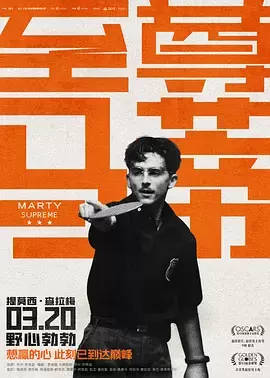
The opening of *Marty the Great* shows Marty (Timothée Chalamet), burdened with a destiny of great responsibility, toiling away in a dimly lit shoe store in New York's Lower East Side in 1952. He's tasked with brainwashing an elderly customer, drugging her and exaggerating the power of a pair of ordinary shoes into a voyage to success. This scene perfectly captures the core driving force of Josh Safdie's cinematic universe: a near-pathological "rush" driven by delirium, lies, and desperate ambition. This first feature film by Josh after the Safdie brothers' split is far from a typical sports biopic; it's a radical exploration of the inner workings of the "American Dream"—a driving force not fueled by idealism, but by a mixture of anxiety, deception, and insatiable self-promotion. With its heart-stopping pacing and Charlama's raw, soul-searching performance, the film reveals Josh Smith as the undisputed "architect" of the Safdie brothers' auteur style. He utterly dismantles the framework of the genre—sports and inspirational films—filling it with his signature, hummingbird-like existential anxiety, forging a reverse ingot of "success": a story about how to relentlessly pursue self-destruction with astonishing talent, only to be bizarrely redeemed at the last moment.
The Safdie brothers' cinematic repertoire is never short of madmen dancing on the edge of a precipice. From *Heaven Knows* to *Good Time*, and then to *Uncut Gems*, they are obsessed with portraying anti-heroes driven by both their own desires and terrible decisions. Marty is undoubtedly the most flamboyant and heart-wrenching of these madmen. Beyond his adrenaline-pumping action and street-smart antics, Marty's stage is more peculiar, and his ambition more absurd: in the almost invisible subculture of ping-pong in postwar America, he aspires to become a world champion and firmly believes his portrait will be printed on Wheaties cereal boxes. This premise creates a sharp contradiction; Marty's tragedy lies in the fact that he possesses genuine talent matching his delusions, yet he throws himself into a field with no commercial value. His "rush" thus transcends a mere struggle for survival, sublimating into an existential performance: he must constantly convince the world, and also himself, that this performance deserves an audience.
Charlama is the perfect embodiment of this existentialist performance. His ambition to "pursue greatness" in this role rivals that of Marty, and is almost the very core of the film's existence. Charlama completely sheds the solitary melancholy and alienation of his roles in *Call Me by Your Name* and *Dune*. He awakens the animalistic spirit within him, his speech rapid-fire, his limbs twitching and spasming as if overcharged, his eyes alternately burning with the insight of a genius and the ghostly fire of a conman. It is precisely this raw charm and audacity that makes it difficult for the audience to completely reject this selfish, willful, cunning, and constantly betraying character. We are as if handcuffed to his wrists, forced to experience every impromptu lie he concocts, every perilous escape. When he launches a relentless pursuit of the washed-up actress Kay Stone, the shameless yet naive mix of electricity is mesmerizing, absurd yet strangely persuasive. This is not a monochrome story about a "nice guy" or an "anti-hero," but a brilliant performance about how "charm" works, how it corrupts, and how it shines with a thieving light.
"Marty the Great" is a sports film that exposes the nervous system. One crisis barely subsides before another, even more absurd, looms ahead. From a New York shoe store to a London luxury hotel, and then to a competition venue in Tokyo, Marty's journey is filled with chance encounters, impromptu scams, and sudden violence. Safdie's camera follows relentlessly, leaving no room to breathe. Even the ping-pong match itself loses the rhythm and cadence typical of sports films, becoming a psychological battle and a struggle of physical exhaustion. The jarring 80s synth-pop music booming against the 50s visuals is not an auditory "error," but an aesthetic deliberate choice. It shatters the nostalgia filter, brutally implanting Marty's inner turmoil and his premature yearning for the future into the narrative with a rhythm and cadence incompatible with that era, thus reinforcing the protagonist's incongruity with his surroundings.
The most striking breakthrough of *Marty the Great* lies in its ending's subversion of the Safdie Brothers' authorial formula. Looking back at their previous works, the glamorous gamblers and outlaws mostly ultimately fall into the abyss of self-inflicted suffering; even if "redemption" exists, it comes at a heavy price. But Marty takes a different path. In his final showdown with Japanese deaf champion Endo, the film suddenly tones down all the gimmicks and anxieties, gazing with an almost classical silence at the most essential core of competitive sports: skill, respect, and the possibility of transcending oneself. Marty doesn't win everything; he may not even have truly changed his opportunistic nature, but in that moment, he briefly sheds the identity of "performer" and becomes a pure "participant." His reconciliation with his girlfriend Rachel is not simply sentimentalism, but an acknowledgment after exhaustion—acknowledging the weight of others' existence and the need to clean up the mess he created.
This ultimately points to the film's deeper allegorical nature; Marty's struggle can be interpreted as "the nightmare that accompanies the struggle for victory outside the mainstream." His Jewish identity, his anxiety in postwar America to break free from class constraints, and his frantic efforts to build his personal brand all transform the story of this ping-pong cheat into a sharp expression of cultural assimilation, American individualism, and its inherent emptiness. Like a satellite mislaunched, he harbors the dandy ambitions of the 1980s, trapped in the conservative shell of the 1950s. His "struggle" thus becomes a generation's arduous attempt to invent their own value out of thin air, to carve out a path for survival in the cracks of history.
Josh Safdie's *Marty the Great*, in its Safdie-esque, violent and chaotic style, puts us through two and a half hours of intense audiovisual pressure, allowing us to experience anxiety, disgust, absurdity, and inexplicable exhilaration. Finally, in a weary tranquility, we glimpse a glimmer of humanity—not in moral self-improvement, but in the willingness, amidst a ruin built of self-aggrandizement and lies, to finally bend down and pick up the ball for someone or something outside of ourselves. This may not be traditional growth, but it is the only scarred maturity that can be recognized in this noisy, distorted era. With this work, Josh Safdie proves that even with the brothers gone, he remains the filmmaker most capable of accurately diagnosing our collective neurosis and providing it with the most discordant yet unforgettable rhapsody.