Peaky Blinders: The Immortal Man
Movie Detail

Peaky Blinders: The Immortal Man

Mar 30, 2026 Drama / History / Crime 6.7/10 5 reviews

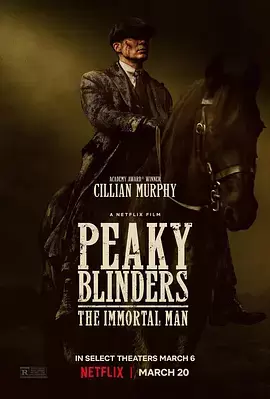
In Birmingham in 1940, amidst the chaos of World War II, Tommy Shelby (Cillian Murphy) returns from self-exile to face the most destructive purge yet. With the future of his family and country hanging in the balance, Tommy must confront the demons within him and choose whether to face them or destroy them.

Writers Steven Knight
Cast Cillian Murphy / Rebecca Ferguson / Tim Roth / Sophie Landau / Barry Keon / and more...
Rating Count 9,254

Related Audience Reviews

5 entries
Sort By
{{ review.userInitial }}
{{ review.title }}

{{ review.userName }}

{{ review.ratingLabel }} {{ review.dateLabel }}

{{ paragraph }}

T
Saving the Madman: Tommy Shelby

Thirteen Too Full nb666

3.5/10 Mar 01, 2026

Tommy Shelby's entire life has been a journey of "saving"—saving his eldest brother, then his youngest; saving his aunt, then his cousin; and even in retirement, he still has to save his own foolish son. The only sensible soul in the family who doesn't need his help—his sister Ada—is even shot in the head (after all these years of retirement, she's finally managed to grow her breasts that big; directors, how could you do that?). Maybe we should rename it: *The Bloodstained Rescue*, *What Can Save You, My Shelby Family*, or *The Bloodstained Nanny: Tommy Shelby's Worried Life*. Three stars: one for the addition of the goddess Rebecca, which definitely brightened the otherwise gloomy plot; one for the background music symbolizing Tommy Shelby's legendary life—"Red Right Hand"; and the final star for the classic line at the end: "I almost had it all, but 'almost' doesn't count." Of course, the second half is a summary of Tommy's life. After all, that's life. Everything you want is within reach, but if you hold onto it for a moment, you can't hold onto it. So, a life without regrets is incomplete; a finale without negative reviews is imperfect.

J
Dust off your newsboy cap

James Lee

4.0/10 Feb 26, 2026

"Leave the wine to Garrison's Tavern, the horses to those who need no labor, the bullets to those whose names have no place to be engraved, and the guns to those who need no use for them."

Tommy is finally reunited with his departed family. His body is surrounded by flames, and ashes drift away in the wind. A legend has come to an end.

The winds of the wasteland swept away the last wisp of smoke. The streets of Birmingham might still be teeming with the Peaky Blinders, but that man would never return, though his infamy would endure. Fortunately, Tommy Shelby did not fall to enemy fire, nor did he perish in his family's infighting. Perhaps, as he wished, all the bloodshed and sins of his life would be reduced to dust in the flames.

With the conclusion of Peaky Blinders: Immortal Legends, the entire Peaky Blinders series has come to a complete end.

From that moment on, the hem of that grey overcoat would never again dart across the streets of Little Heath. From that moment on, those blue eyes would never again coldly scrutinize the world through the smoke. From that moment on, a seat at the Shelby family's dining table would forever remain empty.

But Tommy, somewhere we can't see you—maybe in a poppy field in France, maybe in the room where Grace played the piano, maybe on that summer afternoon before the war started, when you still believed anything was possible—you are there, finally free from all sound.

Complete silence.

Rest in peace, Tommy.

They are free.

Finally, I'm free.

"All things that are bright and beautiful will eventually return to dust." — But beneath the dust, there will finally be no more pain.
t
make

tim3300

3.0/10 Mar 15, 2026

After watching ten minutes of the movie, I knew exactly what was going to happen next. I initially thought it would be a story of the son becoming a traitor, Tommy appearing as a righteous hero, and a plot of sacrificing family for the greater good, perhaps with some blood entanglement and a Hamlet-like feel-good element—that would be mediocre and unremarkable, best left to an NPC. But instead, the son and father were wrestling in a pigsty, getting covered in pig manure. The son suddenly realized his mistake, decided not to be a traitor anymore, and played both sides, ultimately returning to family. He then personally killed his father, becoming the Gypsy King, and that was it. Speaking of character development, I recently watched Barry's Los Angeles Operation, where he played a self-proclaimed genius who was nothing special, an emotionally unstable madman. This movie portrays him similarly: incompetent, brainless, relying on his father's reputation for self-aggrandizement, and morally questionable. Logically, with the death of Tommy, the true leader and soul of the gang, even without entrusting him with a responsibility, the gang would immediately descend into infighting. Even without infighting, the core members would be dead or wounded, and the organization would practically disintegrate. But then the driver's line about being the King of the Gypsies really cracked me up. Such high emotional intelligence! Otherwise, how could you be Shelby's butler? So he's playing the feudal primogeniture game, huh? Regardless of his character, Tommy is now desperate for death, and there's no other way. The old generation of the Razor Breasts are all dead, so it doesn't matter. Passing the torch to the next generation is just wishful thinking. The title of King of the Gypsies in Birmingham is like Gangzi on Ermalu in Ivory Mountain.

L
Tommy's farewell performance marks the end of an era for the legendary Hilby.

LeslieLee

3.0/10 Feb 19, 2026

The new king is a child throughout this film, a child who lacks familial affection, from beginning to end.

The Peaky Blinders of the past were ruthless, but they had principles and family. Duke, however, only learned the methods from his father but not the reasons behind them. Tommy did these things for his family, to fight against the ever-emerging enemies. Thus, the father taught his son a final lesson with his life: with great power comes great responsibility. But I always feel that Tommy is forcing his son to repeat the same mistakes; Duke will live forever in the shadow of patricide, haunted by the same spirit as his father.

What's truly surprising about the film is Tommy's strategic brilliance. The introduction of Tim Roth's character is a far cry from the previous villains in terms of cunning; every step of the scheme unfolds according to Tommy's plan. He anticipates Tommy's visit to the hospital, orchestrates the Liverpool campaign, and even his son. The tests he wrote at the end of the book likely include whether his son will side with him and whether his son will offer him peace. Murphy's inclusion of a significant amount of action in this installment is also a pleasant surprise.

Tommy's death was entirely plot-driven. It's not the final chapter of Peaky Blinders, but rather the prologue to a new generation of the Peaky Blinders. Tommy and Author's story ends in the sixth installment.

T
When the Razor Loses Its Sharpness: Bloodstained Gangsters - An Immortal Legend

Tiger Head

3.0/10 Mar 18, 2026

*Peaky Blinders: The Immortals* attempts to compress a gritty gangster epic into a two-hour film, but the result is like an ill-fitting pair of shoes—losing the series' leisurely pace and failing to extract sufficient dramatic essence. This film, carrying the expectations of countless fans, ultimately becomes a narrative shell crushed by the weight of the plot. The film's biggest problem lies in the confusion and lack of motivation among its characters. Tommy Shelby, a character once richly nuanced in the series, becomes a logically fractured symbol in the film. A ruthless mob boss suddenly standing up for "the nation" against the Nazis—this transformation lacks any believable psychological groundwork. If the series spent six seasons depicting Tommy's struggle in a hell of power and morality, the film crudely simplifies it all to a vague yearning for "redemption." When a character chooses to sacrifice for their country, we need to see their inner transformation, not just treat it as a plot shortcut. Tommy's death thus loses the weight of tragedy, becoming an empty symbol. Even more ironic is the film's treatment of female characters. Polly, the once mysterious Gypsy witch, is reduced to a mere tool for perpetuating the family bloodline. Her plot point of instigating her nephew to kill his father not only betrays the complexity of the character in the series but also exposes the screenwriter's instrumental mindset towards female characters. When a witch is reduced to a representative of "family destiny" instead of a three-dimensional character with her own desires and contradictions, it is undoubtedly a desecration of the spirit of the original work. Duke's transformation is a classic example of plot design failure. A traitor who collaborates with the Nazis, his "reversal" in the latter half lacks any psychological groundwork; his awakening of conscience feels like a magic wand casually wielded by the screenwriter. This stiff character arc exposes the creators' shallow understanding of "complexity"—true complexity is not about fickle behavior but about the core of humanity that can still be discerned amidst contradictions. The only truly bright spot is Tim Roth's portrayal of the Nazi officer. This character stands out from a saturated cast of flat characters precisely because he doesn't require the audience to understand his complexity—pure evil is a complete dramatic entity in itself. While other characters are twisted and deformed under the weight of the plot, this villain feels exceptionally real because of his clear motivations. As a pioneer of American cultural invasion, Netflix's productions have always been simplistic and crude, even its films invested in by the US or the West have become increasingly intellectually simplistic. *Peaky Blinders: Immortals* feels like a product lacking a heartbeat, with a distorted relationship between the individual and the whole. It feels strongly disconnected from the television series. The scene of Shelby riding a black horse through the streets is a similar scene from the beginning of the series. The difference is stark. As the final shot fades, we can't help but ask: besides exploiting fan nostalgia, what is the point of this film? A film that fails to leave a lasting impression, no matter how lavish the visuals, is ultimately fleeting. The story of the Peaky Blinders should have gracefully exited with the lingering echoes of its sixth season, not linger in this soulless film. Netflix should perhaps reflect on this: when algorithms begin to create art, do we get content, or just an empty shell of content?

{{ commentError }} {{ commentSuccess }}