
Song Sung Blue
Based on a true story, the film tells the tale of two down-on-their-luck musicians (Hugh Jackman and Kate Hudson) who form a joyful Neil Deman tribute band, proving that it's never too late to find love and pursue your dreams.

Based on a true story, the film tells the tale of two down-on-their-luck musicians (Hugh Jackman and Kate Hudson) who form a joyful Neil Deman tribute band, proving that it's never too late to find love and pursue your dreams.
{{ paragraph }}
Americans really live a freestyle life. Seeing the male lead's illness, his lack of communication with his family, his reluctance to seek medical attention, his family having a piano, guitar, and VCR but no health insurance, and the female lead's daughter unexpectedly pregnant, I was completely stunned. You guys really don't save money? Are you really living on the brink of financial ruin? When the male lead's daughter appeared, I thought she looked so lesbian!! I almost thought she was going to hook up with the female lead's daughter, hahaha. But then I realized the actress is actually lesbian, and it all makes sense now~
Although I know this isn't the main point of the movie, seeing the overly simplified, idealized, and romanticized smooth and happy ending of the daughter's unexpected pregnancy and the child being given to an infertile couple really made me frown... And it turns out that the singers these two covered were actually from the same era? Is this some kind of society that has no concept of copyright?
"Blues Song" plays the safe card of "multiple characters and multiple storylines equal depth" in contemporary cinema, but unfortunately, this is the easiest way to slip into a monotonous narrative. Each loose end is presented in turn, cross-cutting and settled on a schedule, like managing an emotional table. The characters aren't woven together, but rather piled onto the same narrative checklist. Therefore, each so-called turning point feels more like a process node than the real, choking complexities of life. What makes me even more infuriated is that in 2025, we still see such a blatant and heavy-handed "terminal illness" trope. It's as if the screenwriter pressed an emergency button at the last minute, cramming the story with the least effort. The film itself seems to know this trick is outdated, so it quickly pushes the classic songs to the forefront, trying to let the melody provide depth, the chorus provide comfort, and the audience mistake "familiarity" for "resonance." If I wanted to be academic, I could certainly elevate the discussion, even jokingly suggesting it's a more universal phenomenon. Rock music, repeatedly used in films, has become a portable emotional device, quickly coloring a thin narrative and unifying the audience's emotional spectrum. This "universality" itself deserves a thesis. But frankly, I feel like I'm using academic jargon to find a respectable outlet for my disappointment. The real problem with the film isn't whether it's clichéd, but rather that it uses cliché as a shortcut, using music as a fig leaf, and the power of song as a substitute for emotion. The songs will still be catchy, and they will still resonate, but here they act like soundproofing, masking the film's emptiness and shielding the audience from the more difficult truths. These characters could have been more concrete, more incisive, less smooth, but the film chose the most universal path, expecting us to pay for its universal emotional impact.
A very heartwarming and healing movie.
There will always be days of depression. Write it down as a song, sing it out, and you'll feel better.
Be grateful for what you have.
Be grateful.
You girls are always know the right thing to do.
He was middle-aged, divorced, bankrupt, an alcoholic, stubborn, aloof, and had heart disease.
He met her, who was also middle-aged, divorced, bankrupt, but loved to laugh and was beautiful.
Two middle-aged people fell in love, got married, and encouraged and supported each other.
Life was just starting to look up when shit happens.
She was in a car accident. Amputation, depression, hallucinations, mental hospital. It's hard for a person to smile or be beautiful when they are sick.
Through group therapy, she recovered, stood up again, and returned to the stage.
Another small career peak, and then shit happens.
He suffered a heart attack. He held on until the end of the performance, and then he passed away.
His stepdaughter missed him while repairing a car, and his stepson missed him while watching footage he had filmed.
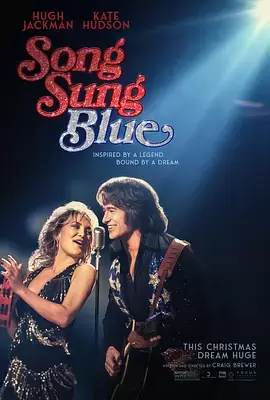
At its core, *Blues Songs* tells the story of a down-on-his-luck musician who finds healing in the melodies of Neil Demand and rediscovers his dreams. Stripped of glamorous filters, the film uses raw footage of cheap rehearsal rooms and street performances to depict the struggles of those chasing their dreams from the bottom of society. Hugh Jackman and Kate Hudson deliver nuanced and deeply moving performances, weaving the characters' repression and resilience into their songs. The director uses a raw cinematic language to make music a weapon against life's hardships, not about the glamour of fame, but about ordinary people finding warmth and redemption in each other's company. The soul of the blues is an inextinguishable hope.