The Rip
Movie Detail

The Rip

Mar 05, 2026 Drama / Action / Mystery 6.6/10 5 reviews

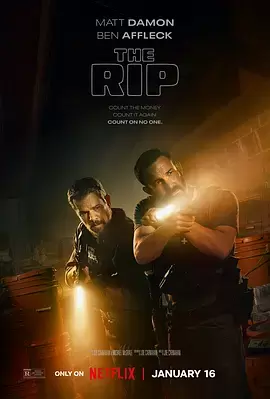
A group of Miami police officers discover millions of dollars in cash in an abandoned hideout, and trust among them begins to crumble. As outsiders learn of the sheer scale of the forfeiture, suspicions swirl. What can be trusted? Who can still be relied upon?

Writers Joe Carnahan / Michael McGregor
Cast Matt Damon / Ben Affleck / Steven Yen / Tiana Taylor / Katarina Sandino Moreno / More...
Rating Count 13,733

Related Audience Reviews

5 entries
Sort By
{{ review.userInitial }}
{{ review.title }}

{{ review.userName }}

{{ review.ratingLabel }} {{ review.dateLabel }}

{{ paragraph }}

D
The main characters in the film really didn't get a penny.

Distribute movies

3.0/10 Jan 21, 2026

Those who insist that the main characters in the film received a share of the money, I'll call them the "money-sharing party."

First of all, I want to emphasize that I have no intention of offending anyone. The main purpose of this post is to try to explain to the "money-sharing party" from another perspective why this film could not possibly express that "the protagonist in the film is greedy for money".

I've seen many well-meaning people explaining various plot details to the "money-sharing" group, trying to clarify the director's intentions. I won't go into those details, because frankly, I believe that anyone who understands film, or whose comprehension is sufficient to understand this movie, can understand it without being taught. And if they don't understand, explaining it to them won't change anything. Again, I don't mean any offense, but I've always believed that some films are incomprehensible to some viewers due to ideological and cognitive differences. There's no right or wrong here. It's like seeing a half-full glass of water: one person might think, "There's still half a glass of water," while another might think, "How come there's only half a glass left?" There's no right or wrong here.

But if we have to say whether it's right or wrong today, then when you watch this film, you're taking the "director's" understanding and intention as "right." To put it simply, if your understanding aligns with the "director's intention," then within the scope of this film, you are right. If your understanding doesn't align with what the director is trying to express, then within this film, you are wrong.

So, getting back to the main point, in my understanding, if you think, "The main character in this movie got a share of the money," then you are indeed wrong. Therefore, I believe that the "money-sharing party's" understanding is absolutely wrong.

First of all, I'm too lazy to explain the plot. As I mentioned above, I personally think it's pointless to explain the plot to "money-sharing parties" because it's a difference in ideology and mindset. This kind of change can't be achieved overnight.

I tried another approach: explaining it from an off-screen perspective. I think this way, the "money-sharing party" (a term referring to those who prioritize financial gain over the main character) should understand more easily.

This is a line from the end of the film. It's a tribute to Jake William, a real person and the inspiration for the film, the son of Chris Casiano. Chris Casiano was a real Miami police officer whose son, Jake William, died of leukemia at the age of 11. This film is based on Casiano's true story, and director Carnahan and Casiano were friends in real life. Therefore, the actor playing the role of Jake William is essentially taking on Casiano's character, hence his own character in the film, who also has a child, and similarly dies of cancer at the age of 11.So the "money-sharing party" should now understand why, in this movie, none of the TNT officers could possibly embezzle a single penny.

Because the director couldn't possibly film it that way; that's not how he filmed it. He made this film with a grand, righteous, and mainstream message.

This film was made by the director as a tribute to his friend Casiano and a tribute to Casiano's deceased son, Jake William (and of course, to earn some extra money; it's work, after all, nothing shameful). If the film subtly alludes to TNT officers taking a cut of the money, and then ends with a line mourning the deceased son, would that be acceptable? Casiano was a consultant for the film and also a friend of the director. If the film were made according to the "money-sharing" interpretation, wouldn't a fight break out? A falling out is a minor issue; using someone's deceased son to stir up trouble goes beyond a simple matter of fighting.

Therefore, in conclusion, let's stop discussing how much money the police officers in the film received. They didn't receive a single penny. That was the director's intention. I've also posted the original interview transcript above; feel free to take a look if you're interested.

If you think there are many shots in the film that "hint" at them splitting the money, then you're misunderstanding. As for why you're wrong, I won't explain it again; too many people could explain it to you, and even if I did, you might not understand. So please stop asking me in the comments, "Explain what that line in that xxx shot meant—it's about splitting the money, isn't it?" I'm too lazy to answer... because even if I did, it might not align your understanding with the director's.

However, regarding the off-screen factor, the director himself conveyed his intentions: to pay tribute to his friend's real-life experience and even incorporate the friend's "deceased child" into the plot. Therefore, it's impossible for this to be about profit sharing; it must be something noble and righteous. I think those who advocate for profit sharing should understand this point.

To be honest, I was waiting for the end credits. They investigated such a huge case; putting aside the money, these people worked themselves to the bone, almost lost their lives, and the team leader even died. Shouldn't they at least get some bonus or compensation? Even if it's not like the whistleblower who gets a percentage that might guarantee them a comfortable life, a small reward would be perfectly reasonable. But in the end, there wasn't a single penny. Absolutely nothing. All that money in the film, the mob boss just threw away… Personally, I think it's like money lying on the ground, nobody caring. You work yourself to the bone all night, they take a wad of it, and the rest is confiscated. I really don't think it's a big deal. LOLO worked an entire night without a penny of overtime pay, and when she got off work, her leg was shot through, her car was totaled, and she had to take a dog home. You take a wad of cash, use it to buy a new car, get your leg treated, and buy Wilbur some canned food to calm her nerves. What's wrong with that? Isn't that reasonable workers' compensation? Of course, I'm not some great, righteous person. I'm just an ordinary citizen, and I can't possibly have the same level of awareness as a narcotics police officer.

So you can say how dirty reality is, but this film can never be dirty.

After all, Casino's reality might truly be that tragic. He was a TNT officer with countless opportunities to earn extra money, numerous chances to jack the rip, yet he never took a single one. Even when his child had leukemia and he didn't have enough money for treatment, he maintained his integrity as a police officer. The director made this film to celebrate this point. Reality may be dirty, and we ourselves may be dirty, but please believe that there are people in this world who are so upright that you can't understand them. We can't become them, and we can't even understand them, but at least we can learn to respect them.

By the way, Americans seem to be really good to dogs under their ideology. Even with war approaching, Dane didn't forget to put a bulletproof vest on Wilbur. Humans need bulletproof vests, and dogs need them too! How touching.
T
How can it be so good?

Tonight

3.0/10 Jan 01, 2025

How could it be so perfect? ​​The white police officer is incorruptible, even going bankrupt because his son has cancer, yet he doesn't embezzle. Instead, Asian and Latino white officers are portrayed as corrupt. Do you believe this kind of arrangement? On the other hand, the chief doesn't embezzle, the captain doesn't embezzle, the team leader doesn't embezzle, but an insignificant nobody, along with the DEA action team leader, embezzles. Not only are the higher-ups unaware, but they also secretly investigate and eliminate them. The director says, "That's the point. Everyone knows Asian Americans are reliable, so I'll give you a little twist. Didn't expect that, did you?" Indeed, no one expected it. Asian Americans are the poorest group in America, and in the end, they risk their lives, dragging their money through gunfire. And you even cast Steven Yeun, a Korean-American actor with amazing skin. Did he embezzle to buy expensive skincare products? What was supposed to be a thrilling zero-sum game of ulterior motives suddenly takes a sharp turn, becoming a propaganda film promoting positive American police values.

Putting all that aside, can you explain the bad guys' thought process? As the DEA team leader, he has so many opportunities to handle this kind of money and deal with drug lords, why would he risk his life for a pittance? At first, I thought this money was stolen from the corrupt cops, but then the drug lord suddenly admitted it was his own money and refused to take it! The drug lord doesn't want the money because he's afraid of the police. What kind of positive story is this? Haven't you guys seen "No Country for Old Men"? If the drug lord is so afraid of the consequences of harming the police, why don't the DEA guys just ask the drug lord for the money directly? Why go through all the trouble of robbing him?

This all feels like a film made under the guidance of the State Administration of Radio, Film and Television. The protagonist remains true to his original aspirations and upholds his ideals; the righteous path is fraught with hardship, but justice, though delayed, will eventually arrive. The bad guys aren't leaders, neighboring countries, specific groups, ethnic minorities, or organized crime, but a small group of individuals who have abandoned their ideals and become corrupt and degenerate. Who are they? It's China! How can China be so evil, secretly monitoring and informing on others, and ruining our glorious little community? White people storm Capitol Hill with overwhelming force, black people rob Apple stores with fervor, and Mexicans diligently sell drugs and prostitutes, while you Asians, with your education and writing, are bringing disaster to the country and its people.

L
(A short review isn't enough, so I'm just rambling on about a popcorn movie.)

Liu Sanxing

3.0/10 Jan 01, 2025

Typical: big-name cast + mediocre director + mediocre script, a formulaic production focused primarily on dialogue. The mole is revealed too early, forcing the film to rely on action sequences to keep things going. Unfortunately, the film as a whole isn't an action movie; it's more like a game of Werewolf—so the so-called climax isn't the climax of the story, and the exciting scenes feel like a perfunctory, fake climax.

To improve quality within a given budget, directors have limited options, and big-name stars are also limited; the only solution is to focus on the script. With the development of AI and the ever-expanding influence of social media content, a clear dividing line will gradually emerge in film screenwriting.

Of course, no matter how AI develops, even if it eventually becomes possible for "one person to make movies with AI," isn't the result obvious? What's truly lacking are screenwriters. AI struggles to produce top-notch original content, while film desperately craves such original work.

Moreover, by then, AI will have also solved the problem of shooting costs. Along with the reduction in costs, AI will liberate the camera—and every major development in film has been inseparable from the liberation of the camera.

From everyone becoming literate, to everyone being able to write, to everyone having internet access, to everyone being able to shoot videos, perhaps in the future everyone will be able to make movies using AI. But birth disparities, social circles, information gaps... these are not things that technological development can solve.

A joke comes to mind: "The poor rely on mutation, the rich rely on technology." From another perspective, as social stratification intensifies, the poor can only break through by realizing their absolute talents, while the rich can simply work steadily and gradually monopolize the market.

If we broaden our perspective, interstellar migration is highly likely to be achieved before the elimination of social classes. At that time, Earthlings might become a new generation of "slaves," and the class gap might widen even further. The last chance for ordinary people may lie in the window of opportunity before the wealthy fully master gene editing and limb regeneration technologies.

During this period, revolutionaries who believe that "humanity has come this far through unity" will inevitably emerge to challenge social injustices. Along this path, numerous troublesome issues, such as those related to religion, will also need to be addressed.

P
Just writing something

POI

3.0/10 Jan 01, 2025

Why not cast Ben Affleck's brother as his brother (although Scott Adkins would have been fine, he's quite capable)? The villain was easy to guess. The moment I saw that the only other guy in the team besides Affleck and Matt Damon was Asian and looked so troubled, and considering Kyle Chandler has played many villains, I knew who the mole was. Only after watching did I realize the female informant was Supergirl from The Flash. PS: Why not share some of the money they made with the indebted, deceased, and unpaid police officers who still worked so hard? The plot felt a bit chaotic and didn't flow smoothly. The atmosphere of suspicion and distrust in the looted house and armored vehicle was excellent, but the ending was too conventional (outdated). Milkyway Image used to be good at this kind of film, and the stories were very smooth, but unfortunately, Hong Kong cinema has declined.

Excerpt: The film opens with the murder of a policewoman, followed by a series of one-on-one interrogations, leaving viewers confused about the group's purpose. The main plot only becomes clear when the group discovers the stolen money. The latter half features a series of scenes including catching an undercover agent, car chases, and gunfights. It's not bad, but Hollywood has made too many films with similar plots, resulting in mediocrity. It's not terrible, but it's unremarkable; a popcorn flick for casual entertainment.

Overall, it's alright. Some details don't hold up to scrutiny, but the overall execution is good, and the final twist is somewhat convincing. The only downside is that it's a bit too idealistic and righteous; the visuals are dark and the gunfight scenes aren't great. It's not a masterpiece; just treat it like a short comedy.

X
The movie, and then, leaving the theater. ...

Xu Ji White Rabbit

3.0/10 Feb 06, 2026

I watched the crime film "The RIP" starring Matt Damon and Ben Affleck.

This is a web movie. Yes. A streaming movie released on Netflix.

The first thing that popped into my mind was this phrase: "Movie, then leave the theater."

"The Confiscated Letter" is, to be honest, a movie that's hard to dislike but also doesn't leave a lasting impression.

It's adequately completed. It has all the necessary elements. The pacing is clear and steady. However, it ultimately remains "safe and mediocre."

The story is very simple: a narcotics police team, struggling financially but determined, faces a mole within the organization and the allure of millions of dollars in undisclosed drug money, leading to a crisis of trust within the team. Assassinations, eliminating traitors, tests, and plot twists unfold layer by layer, with a straightforward storyline that requires almost no skill to understand.

From a genre perspective, *The Confiscated Letter* is adept at all the narrative grammar of crime films. It knows how to create tension, how to maintain suspense through a chain of suspicion, and where to throw in a plot twist. But the problem lies precisely in the fact that it knows "how to film" too well, yet rarely asks "can it still be...?"

The film's treatment of "justice" is exceptionally clean, with the characters' moral stances almost flawlessly purified. This seems detached from the realities of the 2026 world. Such a story, lacking the ability to address real-world issues, avoids touching upon the public consensus on police corruption, abuse of power, and systemic injustice, instead creating rifts within its narrative of "purging the mole." Each time the story approaches the gray areas of human nature, it abruptly retreats, returning to a safe, upright, and unassailable stance of righteousness.

A film reuniting Matt Damon and Ben Affleck, seemingly solid, ultimately lacks the creative brilliance expected of them.

I know that my "unresolved feelings" stem from the fact that at this point in time, when "The Confiscated Letter" is placed in a larger media environment, its "mediocrity" seems particularly relevant to the times.

As a streaming blockbuster, it almost completely abandons any imagination of the cinematic experience. This is a precisely calculated "living room movie"—suitable for distracted viewing, suitable for pausing and rewinding, and also suitable for being quickly consumed and quickly forgotten through algorithmic recommendations.

In this respect, it shares an intriguing commonality with the currently popular micro-dramas in China. Micro-dramas embrace fragmentation and competition for attention, directly transforming "distraction" into a narrative strategy; "Confiscation of All Trust" merely retains the shell of a film, and in terms of viewing logic, it is aligning itself with short content.

When movies leave the cinema—and enter the living room, enter the realm of algorithms—what they lose is not just the scale of the screen, but also the reason for watching that demands undivided attention and cannot be fast-forwarded. Streaming movies no longer require the audience's full attention; they only need to be clicked and "effectively played." Understanding risks is actively avoided, and the sharpness of expression is pre-smoothed, making film works cautious and safe.

Seeing Matt Damon and Ben Affleck together again evoked deep emotions in me. They are my age. Back then, they were so young, full of creativity and storytelling ambition. They entered the public eye with "Good Will Hunting," representing an era of creative cinema that believed in originality, auteurship, genuine emotion, and that "film can change destiny."

At that time, Hollywood was not yet completely dominated by IP, algorithms, and risk assessment. Original screenplays were still regarded as the right path to the mainstream, and young creators could break into the core of the industrial system with a sharp and personal work.

The success of "Good Will Hunting" represented not only the success of the two actors, but also a creative belief: stories originate from personal experience, and characters are allowed to be vulnerable and flawed. Movies require the audience to stop and listen, and even to reflect on and understand the anxieties of growth, humanity, and the world.

In January 2026, with its first streaming feature film of the year, Netflix will no longer attempt to explore new avenues of expression, but will instead comfortably integrate into the mainstream of content. I don't want an era where "movies leave the theater."

{{ commentError }} {{ commentSuccess }}