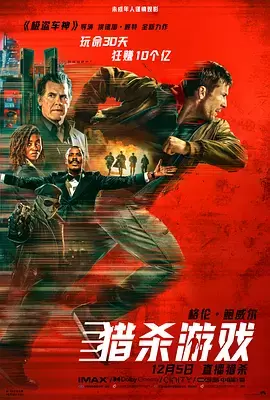
I watched the newly released film *The Hunt* today. Overall, while the film may seem mediocre to some extent, it is undoubtedly a typical example of a contemporary film that flexibly incorporates the latest social issues. The film reflects contemporary reflections on media tyranny, especially after capitalism has developed to a new stage, where the human body and life have become objects of capitalist consumption in the process of labor reproduction. These two points precisely capture the very contemporary characteristics of economic development and cultural reproduction.
First, from a media perspective, the film reflects on the idea that we live in a world of total surveillance, a concept similar to the metaphors in *The Truman Show* or the Chinese film *The Unknown*. We are surrounded by a world spied on through media terminals—especially screens. While *The Truman Show* did not depict such direct surveillance and consumption, later works with a Korean setting, such as *The Squid Game*, and this year's *The Hunt*, show death performances dominated by capitalists. These capitalized struggles for life and death are presented not only through surveillance and games but also, through the revival of traditional concepts like "hero" and "knight," reveal modern society's yearning for traditional values such as sacrifice and family honor.
This film highlights core values: a father risking his life to save his sick daughter, and the necessity for men to shoulder family responsibilities. But more importantly, it presents a media-driven dystopia. In the film, the media not only shapes our perspective on things but also meticulously designs what we can and cannot see. Who is portrayed as a hero and who is depicted as an executioner is not determined by ourselves but by capital.
This process of "watching" is itself a manifestation of media reflexivity. When we see characters watching on screen, and when we voyeurize through the medium of film, we also see how humanity's voyeuristic desires gradually evolve into a yearning to watch others die. Life and death become a gamble, part of the performance. This phenomenon reflects the close connection between media consumption and the entertainment of violence in modern society.
Secondly, capitalism has entered a new stage of development. In Marx's classic theory of *Capital*, the basic life elements necessary to maintain labor power are crucial in the reproduction of capitalist productive forces. For example, at the biological level, labor power needs medical treatment when sick, sufficient food, rest and sleep, and the support of families and children to prepare for the production of the next generation of labor power. These are all indispensable links in the reproduction of labor power. However, in the context of contemporary capitalism, the human body is no longer the absolute basis for reproduction, but has been consumerized and commodified by capital, becoming an object of the market and entertainment.
In the classic era of capitalism, it essentially fulfilled the basic elements required for the reproduction of labor power. However, with the advancement of the new technological revolution, especially the emergence of artificial intelligence, some labor power seems to have become less important, becoming so-called "surplus labor," social outcasts, those who want to work but cannot get the opportunity. At the same time, the exploitation of capital has entered a new stage. Many people are not only excluded from the labor market, but even the value of their work itself gradually disappears. Thus, something originally priceless—life—has become a commodity with a price tag, rewarded with bonuses, and even considered something that can be "lost." This phenomenon is unprecedented in history.
Through "The Squid Game" and "The Hunting Game," we see this phenomenon manifested: capitalists buy and sell ordinary people's lives as commodities, watching their deaths unfold. These lives are no longer priceless, even if done in the name of family value or honor, but rather objects to be exploited and consumed. The body, originally an object of labor reproduction, has now become a consumer good.