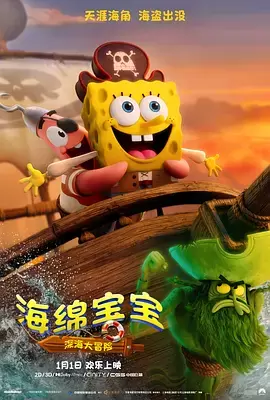
I've always believed that SpongeBob SquarePants is essentially an animated show aimed at an adult audience. Unlike The Simpsons, which throws out explicit jokes related to the social environment, SpongeBob SquarePants uses a more subtle, seemingly foolish approach to gently satirize idealism in reality.
I haven't systematically watched SpongeBob SquarePants; I mostly watched it with my nephews and nieces as they grew up, during trips back to my hometown. I noticed that when other cartoons were on TV, they would quickly switch to others, but when SpongeBob came on, they would stop and watch for a long time. I would often ask them somewhat awkwardly, "Is this really suitable for you?"—especially since Squidward's nose and eyes have a slightly strange appearance, and there are many related parodies online, even with this movie, *SpongeBob SquarePants: The Great Adventure in the Deep*. The opening scene of the movie, with the bubble-blowing scene and the frozen shot of the bursting bubble, seemed to me to have a special metaphorical meaning.
However, compared to the short and lighthearted series, *SpongeBob SquarePants: The Deep Sea Adventure* does explore a core theme more deeply. When I watched the show with my nephew before, I noticed how Mr. Krabs exploited SpongeBob's naiveté for personal gain, while SpongeBob and Patrick always managed to overcome difficulties and reap their rewards through a kind of "foolish luck"—their innocent "powers."
From my perspective, SpongeBob SquarePants has always been a work that satirizes workplace realities and utilitarianism in a short and fast-paced way. However, after watching this feature film, I felt that in 2026, many years after the IP's inception, it touched upon more contemporary social issues—beneath its seemingly unintentional emphasis on gender issues, it tells a story about how "excessive masculinity can harm oneself and others." This is also the first time in the SpongeBob SquarePants series that gender-related concepts have been introduced so explicitly.
There's been a long-standing online debate about whether SpongeBob SquarePants is a boy or a girl. Before this, I thought the most brilliant aspect of the series was that places like the Krusty Krab restaurant acted as gender-neutral spaces—what gender could SpongeBob possibly have? While Patrick's voice acting is somewhat masculine, the animation doesn't use gender as a central conflict, which is actually a very child-friendly approach. Children can understand the story simply through dimensions like sincerity versus hypocrisy, pragmatism versus purity, success versus failure.
However, in *Deep Sea Adventure*, you can clearly feel the budding sense of "masculinity" in SpongeBob. At the beginning of the film, he longs to grow taller to meet the height requirements of the amusement park rides—though it's not discrimination, but rather for safety reasons. This actually raises the issue of anxiety about masculinity. However, in 2026, the discussion about "excessive masculinity" has actually passed its most heated phase, making me feel that the film didn't quite catch the "hot" topic at the right time. This reminds me of "Boonie Bears: Reverse Time," released in the same year. That film, through the setting of parallel universes, tells the story of Bald Qiang leaving his working life in Shenzhen and returning to nature, exploring how to find one's true self in modern utilitarian society. A similar theme of "returning to one's original intention" is now continued in "SpongeBob SquarePants: Deep Sea Adventure" through the lens of "masculine reflection," but in my opinion, it comes a little too late.
Today is January 1, 2026, New Year's Day. I chose to watch "SpongeBob SquarePants: The Great Adventure in the Deep Sea" both to relax and as a way to do some "homework" in advance for watching cartoons with my children in the future.
1. The belated arrival of IP imagery and gender issues
This time, I specifically chose a preview screening at a movie theater, and many longtime fans were there. I grew up watching TV in my village, so I wasn't really familiar with this IP—it's more like an animation that city kids are familiar with. My understanding of SpongeBob SquarePants comes entirely from watching it with my two nephews after I started working. But this movie gave me a lot of different experiences.
SpongeBob SquarePants's character is explored in depth over a period of nearly an hour and a half, with plot twists and turns that propel the story forward – a narrative pace rarely seen in the series. Furthermore, the chemistry between SpongeBob and Patrick remains excellent; one is persistent in playing the fool, while the other excels at witty banter, making for a consistently entertaining pairing.
Mr. Krabs' character development also felt fresh to me—this time, he's not just exploiting SpongeBob's naivety to make money, but rather a key figure full of positive energy, even propelling SpongeBob on his journey to pursue "manliness" because of a momentary boast. The process of him and Squidward, this "life-saving duo," working together to rescue SpongeBob and Patrick is full of laughs and heartwarming moments, and it left me with many thoughts in the theater.
2. A visual feast and the irreplaceable role of cinemas
Watching it in a theater on New Year's Day was incredibly immersive. In my opinion, the visual presentation of many scenes is on par with *Avatar 3: Mountains and Ashes*—despite their vastly different styles, one realistic and the other abstract. But for someone like me who works in art, what excites me most isn't how realistic the visuals are, but rather the satire and expressiveness inherent in the designs. From this perspective, *SpongeBob SquarePants* is remarkably sophisticated.
Watching this film in the theater was a truly immersive visual experience. Although it was produced in 3D, the surface textures still retained a 2D feel, a style that has become quite popular in recent years. The production team didn't overemphasize the details of the bubbles or textures on the sponge's surface, but rather used these elements very sparingly, focusing on key areas.
For example, the holes on SpongeBob's body: when his facial muscles move, those cheese-like holes don't distort or deform with the skin texture, but remain relatively independent. This maintains the overall stable texture of a 2D cartoon, avoiding any jarring or deformed appearance. The film even intersperses a few frames of purely 2D footage—I suspect few people in the audience noticed—all these techniques actually serve the plot.
The depiction of "bubbles" in the film is particularly brilliant. Bubbles not only symbolize the childlike interactions between SpongeBob and Patrick, but their transparent texture and the handling of light and shadow are also incredibly delicate. Several single-take 3D camera movements even gave me a brief feeling of weightlessness in my theater seat. This experience is something the TV short version simply cannot provide—I truly felt like I had entered SpongeBob's world. It's safe to say that watching this film in a theater was the most exhilarating experience for me.
3. Adult resonance and children's confusion
However, although there were many children in the audience, I don't think this film is entirely suitable for younger viewers. Many children showed signs of fear halfway through—while the characters' designs seem inspired by children's doodles, such as their distorted limbs and naive lines, the way these "children's drawings" are given a three-dimensional quality and vividly presented on the big screen actually creates a subtle sense of unease. This style, somewhere between innocence and horror, may be the way the film's theme needs to be expressed, but it may not be suitable for all young viewers.
In my personal opinion, this film is actually more suitable for adults—many adult audience members were more engaged than the children. It tells the story of how the societal indoctrination of "masculinity" is constructed in men from childhood, and how, after we've established ourselves and started families, we may one day discover that this quality doesn't always have practical function, sometimes becoming a label that allows others to exploit us or that binds us. I won't go into more specific areas here, but many parents, upon seeing certain scenes, probably couldn't help but ask themselves: Should we continue to demand "masculinity" from the next generation? Should we reflect on the impact of these stereotypes on our children's choices?
In my opinion, this is the true theme of the film. While it appears to be an animation for children, it also serves as a reminder to the adults accompanying them: should we encourage children to pursue so-called "successful" socialized models, or should we protect their innocence, sincerity, and optimism—like SpongeBob SquarePants'—that almost fatalistic pure belief that good things will happen and that they will actually attract good things?
So, SpongeBob isn't stupid, and Patrick isn't just a comedic duo. In this story, they once again demonstrate a kind of innocent wisdom. Of course, this is a very personal, adult-oriented interpretation. Children might not understand it this way, but good works are often like that: they can make children laugh out loud, and also make adults lower their heads and think.
The above is my diary entry after watching "SpongeBob SquarePants: The Deep Sea Adventure" in the cinema on New Year's Day 2026.